
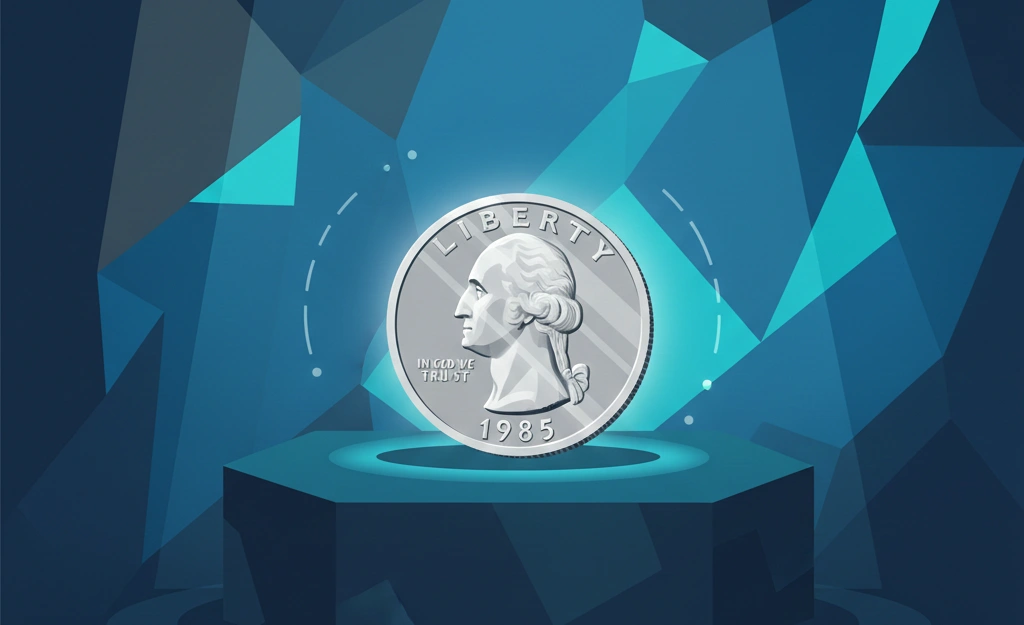
The Washington Quarter issued in 1985 represents an object of market 1985 quarter value analysis based on mintage data and auction performance statistics.

This year features a total absence of precious metals in the alloy, determining price dependence exclusively on surface preservation and the rarity of a specific mint mark.
The total output of coins in 1985 exceeded 1.2 billion units.
Mint Facility | Mint Mark | Mintage | Strike Type |
Philadelphia | P | 775,818,962 | Circulation |
Denver | D | 519,962,888 | Circulation |
San Francisco | S | 3,362,821 | Proof |
High mintage of regular strike coins limits the value growth of specimens found in circulation.
Coins showing signs of wear are valued at their face value.
Specifications
Adherence to established physical parameters guarantees coin authenticity, allowing for the identification of anomalies.
Mass: 5.67 grams.
Diameter: 24.26 millimeters.
Thickness: 1.75 millimeters.
Composition: Copper-nickel cladding (75% copper, 25% nickel) applied to a pure copper core.
Edge: Reeded (119 reeds).
A weight deviation exceeding 0.194 grams indicates a production error or the use of a non-standard planchet.
The market price of the 1985 quarter demonstrates exponential growth upon reaching the MS67 grade.
Grade | 1985-P (USD) | 1985-D (USD) | 1985-S Proof (USD) |
MS63 | 1.00 | 1.00 | - |
MS65 | 5.00 | 7.00 | - |
MS66 | 18.00 | 25.00 | 7.00 |
MS67 | 210.00 | 145.00 | 15.00 |
MS67+ | 650.00 | 375.00 | - |
PR70 DCAM | - | - | 110.00 |
Pricing reflects a shortage of coins in exceptional preservation resulting from the mass transportation method in canvas bags.
Contact between coins caused the formation of micro-scratches preventing the acquisition of the highest grades.
Record Auction Sales
Auction statistics record the maximum amounts paid for lots of the highest category.
1985-P MS67: Sold at Heritage Auctions in 2019 for 1,140 USD.
1985-D MS67: Realized in 2017 at a price of 541 USD.
1985-S PR70 DCAM: The maximum price was recorded at 225 USD in 2021.
Analysis shows a price decrease for Proof category coins of 4-6% annually due to an oversupply of certified specimens.
Regular strike coins in grade MS67+, by contrast, demonstrate an average annual price increase within 3.5%.
Production Defects and Mint Errors
The discovery of defects confirmed by expert organizations significantly increases the value of a standard quarter.
Off-Center Strike
The displacement occurs during the incorrect positioning of the planchet in the minting press.
10-15% displacement: 25–40 USD.
50% displacement retaining the date: 150–280 USD.
The absence of a date on an off-center coin reduces the value by 60%.
Double Die
Cases of doubling on obverse or reverse elements occur on 1985 coins.
The most pronounced doubling is observed on the inscriptions "LIBERTY" and "IN GOD WE TRUST."
The value of such specimens varies from 50 to 150 USD depending on the intensity of the defect.
Wrong Planchet
A rare type of error involving the use of a planchet of a different denomination.
Struck on a 5-cent planchet (weight 5.0 g): 400–750 USD.
Struck on a 1-cent planchet (weight 2.5 g): 600–1,100 USD.
Using spectral analysis allows for the confirmation of such errors, excluding chemical etching.
Attractiveness of 1985-P and 1985-D
The Philadelphia Mint produced 49% more coins compared to Denver.
Despite this, coins with the "P" mark in the highest preservation are valued higher due to the poorer quality of the used dies.
Rapid wear of the working die surfaces in Philadelphia led to the blurring of fine relief details.
Finding a sharply struck 1985-P specimen constitutes a more difficult technical task.
Market Value Forecast
Forecasting is based on current inflation and the rates of Population Report updates.
MS65-MS66 Segment: Price stability is expected with fluctuations of no more than 2% per year.
MS67+ Segment: A growth of 15-20% is projected by 2030 due to the reduction in the number of unopened bank rolls.
Proof Segment: Further price reduction to the level of 80-90 dollars for the highest grade is likely due to the lack of scarcity.
Changing the grading methodology by certification companies may lead to price corrections downward upon mass assignment of high scores.
Self-Inspection Methodology
Checking a coin before submitting it for professional certification includes several stages.
A necessary condition is the use of magnifying devices with at least a coin checker app.
Checking Central Points: Inspecting Washington's hair above the ear and the eagle's breast feathers.
Field Analysis: Identifying deep scratches interrupting the lines of mint luster.
Rim Evaluation: Searching for signs of mechanical impact imitating mint errors.
A specimen having at least one contact point on the cheek of the portrait cannot claim a grade higher than MS66.
Impact of Die State on Price
The condition of the die directly affects the detail of the image.
Coins struck by worn dies have characteristic radial lines ("sunbursts") on the fields.
Such signs reduce numismatic attractiveness even in the absence of physical wear.
Specimens demonstrating an Early Die State possess increased clarity and are valued 10-15% above the average.
Liquidity and Sales Channels
The liquidity of 1985 coins depends on the presence of a certificate (slab) from recognized companies (PCGS, NGC).
Uncertified coins possessing MS67 potential are sold 40-50% cheaper than the market price of the grade.
The main platforms for selling lots valued above 500 dollars remain specialized auction houses.
Low-price segment coins (up to 50 dollars) are sold mainly through online platforms with high commission fees.
Conclusion
The 1985 quarter is a typical representative of US copper-nickel coinage.
The primary value is concentrated in a narrow segment of specimens with grade MS67 and higher, and can be identified with the coin value app.
The lack of investment potential for coins from circulation is confirmed by the massive mintage exceeding one billion units.
Investing in this year requires a deep understanding of preservation grading and monitoring of auction statistics.